
















Battala – printing, publication, pornography … and penmanship.
The “Gora Sahibs” were concentrated in their White Town around Fort William – down Chowringhee, all the way to Park Street. The natives were huddled in the squalor, as the river flowed, both up and down, in what was variously, contemptuously called the Black Town. And in this black town had flourished – read, spontaneously flowered – a printing and publication ecosystem the kind of which has had very few parallels in history. It is not a place that the average “Bhadrolok” wants to venture into because of its sub-altern nature; because, though it published everything from religious texts and self-help books to popular literature, it has long been stamped as the purveyor of pornography (“asleelata”); and because of its geographical (and perceived spiritual) proximity to its sibling Sonagachi. I write this piece for a reason – as a fountain pen lover, I realise that the use of pen and ink is inextricably linked with this story of ephemera, and it needs another recounting.
Printing presses were not new to Calcutta – the first ones were set up around the Fort and Lal Dighi as early as the late 1770s and 1780s. But these were European-owned, and this story really originates with the establishment of the Serampore Mission Press in 1800 by William Carey, which pioneered Bengali typography through Panchanan Karmakar. The first native-owned press was set up by Babu Ram in 1807 somewhere in Khidirpur and was later moved to Pataldanga, in the College Street area. The first indigenous printing presses began appearing in the Battala (Bortolla) area only in the 1810s and 1820s.
But where exactly was Battala? Legend has it that it was literally where the name suggests – under a massive Banyan tree and stretched along the eastern banks of the river Hooghly, encompassing Sovabazar, Shyam Bazar, and Kumartuli, though the geographical spread has been variously listed. Suffice it to say, Chitpur Road (now Rabindra Sarani) was the main thoroughfare around which (in the lanes and by-lanes) the main publishers, booksellers, paper merchants, and wood-block artists had set up shop.
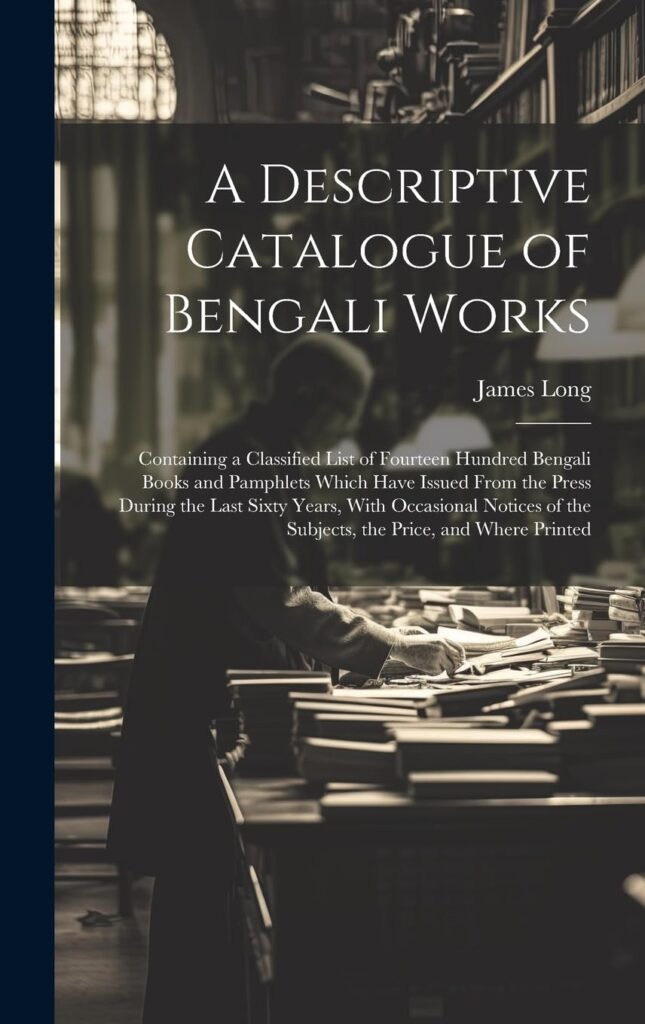
Battala reached its peak in the 1850s, and according to “A Descriptive Catalogue of Bengali Works” (1855) by Reverend James Long, there were approximately 1400 Bengali titles. Another interesting statistic points to as many as 46 printing presses, collectively printing over 570,000 copies by the year 1857, with average print runs of 2000 to 3000. Consider this with the 1872 census figures in the background, which estimated an overall adult literacy rate of roughly 3.2% and an estimated female literacy rate of only about 0.5%.
Battala had, in less than half a century, democratised print by providing cheap, locally produced, “contemporary” content to the middle and the lower classes, creating in its wake a thriving ecosystem, not only of printers, publishers and writers, but also of readers, across divides of class, culture and gender. They also hired jhakawalas – peddlers who literally carried books on their heads and reached the far-flung readers, even the antorpur-bashinis (women confined or secluded within the inner quarters of traditional households), in a rare form of outreach and empowerment. In this context, Battala’s contribution to the spread of literacy is often ignored, as the Bhadroloks of the day – the Rulers and Elites alike – demonised it for only serving sin. They scornfully singled out the Prohoshon (farce), overlooked the Ponjika (almanac) and created such a ruckus that the Obscene Books and Pictures Act (1856) was passed, in effect labelling an entire industry as publishers of amoral Chap Books. An example of the Victorian era flexing its moral muscles.
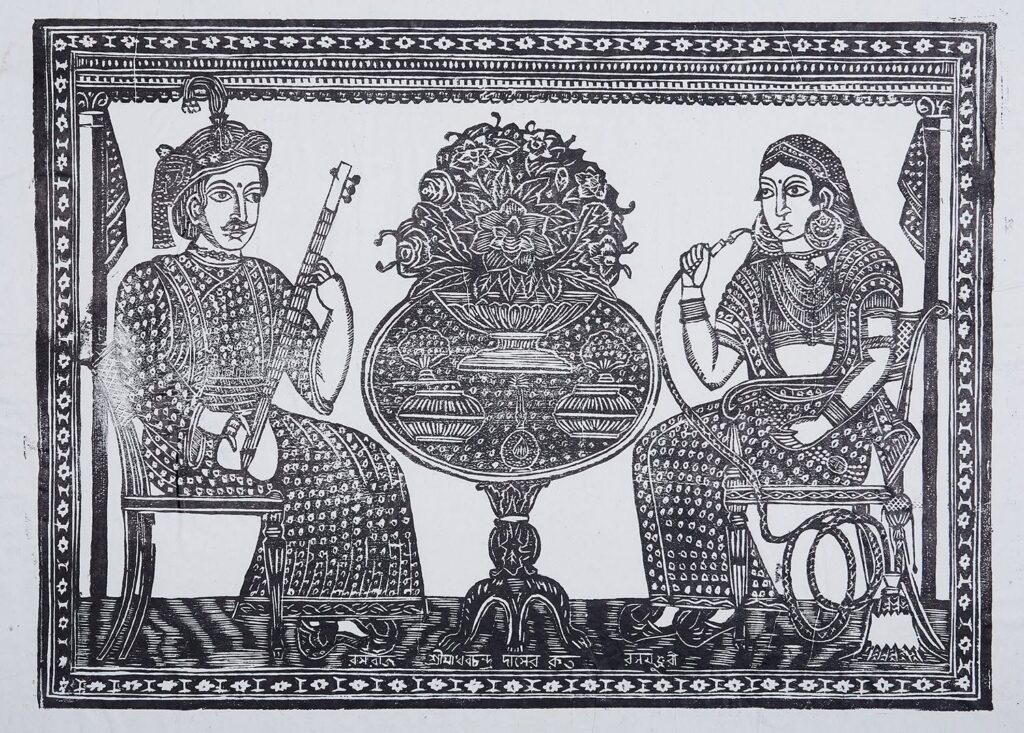
Battala’s contribution to the development of woodcuts as an art form – illustrations in books that made them accessible even to illiterates cannot be overemphasised. But more important was its role in freeing the Bengali language from the clutches of the pundits, stripping it of its Sanskrit hyperbole and making it available to the masses. In this connection, mention must be made of the Derozians (Young Bengal), who though they looked down upon Battala print culture as vulgar, coarse, “native” and sexually explicit, helped Battala find its moorings in the churn with their single-minded devotion to imbibing Western knowledge, rubbishing the comatose societal norms of the day and penning-in the fresh air both in English and the Vernacular languages. The Battala printers who lampooned the Bohemian lifestyle, overindulgence in wine, and holier-than-thou attitude of the Young Bengal, actually, in a perverse way, strengthened their movement on a deeper level, however caustic they may have sounded superficially. In this, the writers and publishers of Battala, on the one hand and the followers of Henry Louis Vivian Derozio were fighting the same forces of darkness, albeit from different ends. High Literature and Plebeian Accessibility, if you will, creating in the process a vibrant, multi-dimensional, multi-layered Bengali space that dared to look out from the well it was in.
The period – between the establishment of the Serampore Mission Press in 1800 and the publication of Reverend James Long’s catalogue in 1855, was one in which Calcutta also witnessed the establishment of educational institutions with a consistency that was neither seen before nor has been viewed since. It started with the Fort William College in 1800, followed by the Hindoo College in 1817 (now Presidency University), Serampore College (1818), Hare School (1823), Sanskrit College (1824), General Assembly’s Institution (now Scottish Church College, 1830), Calcutta Medical College (1835), La Martiniere (1836) and Bethune School (1849).
The Civil Engineering College (1856, now IIEST), University of Calcutta (1857), St Xavier’s College (1860, now University). IACS (1872), and Bethune College (1879) had followed suit.
The early 19th century was therefore marked by not only the democratisation of knowledge and access to the written word, but also by the establishment of academic institutions and the proliferation of printed material churned out by Battala. Naturally, the demand for writing instruments had also increased exponentially. Khager Kolom (reed pens), which were the writing instruments of the day (along with the soot-based, home-made inks), could not keep pace with the demand created by the printing presses and the clamour for a writing instrument in keeping with the fast pace of the times was felt.
The answer was provided when commercially mass-produced steel nibs were introduced to the market from far away Birmingham. Attach one to a wooden rod (or handle), dip it into the inkwell, and voila, one could write forever! John Mitchell of Birmingham started producing pens with metal nibs in 1822, and it wasn’t long after that they were introduced in the then capital of the Company Raj. The pens and the accompanying inks were mostly imported.

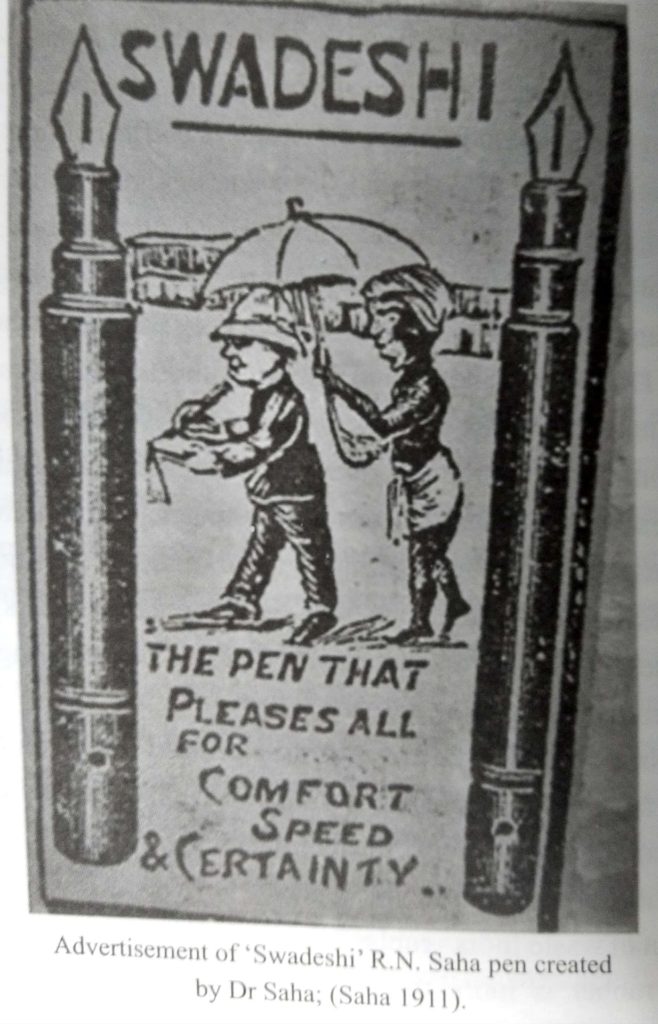
It wasn’t till 1883 that the first locally made commercial inks were successfully marketed, when P M Bagchi & Co pioneered the same (Aniline, the dye used in inks was first isolated in 1826 by German chemist Otto Unverdorben, PM Bagchi debarred from importing it by the British had developed an indigenous substitute). There would be a lull following PM Bagchi’s initial forays, till Dr Radhika Nath Saha introduced to the world his patented “Stylo” pens at the turn of the century. The prototype was created by a local craftsman in 1903 or thereabouts. Dr RN Saha also made and sold his own ink.

F N Gooptu, back from a tour of England ventured into the manufacture of dip pen handles in 1905, moving into related fields of wood pencil manufacture and later into commercially produced fountain pens (Gooptu’s Perfection). Initially, production started from the Gooptu residence in Middleton Street and was then shifted to the factory in Beliaghata, which was later blessed by Mahatma Gandhi’s visit.
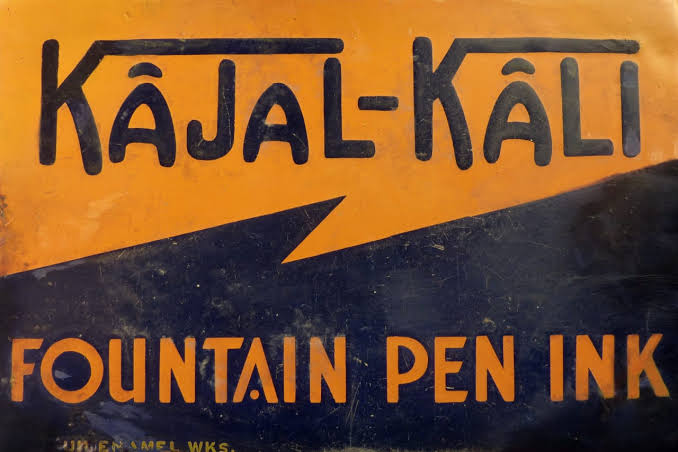
The next milestone in pen and ink making history of Calcutta was the establishment of Kajal Kali by three students of Shantiniketan in 1924. This ink was blessed by Gurudev Rabindranath Tagore. As a matter of fact, Rabindranath had gone so far as to endorse this ink in advertisements placed by the brand.
Rabindranath Tagore is also known to have launched the Bharati pen, which was unveiled in the early 1930’s by G C Law & Co. (not G C Laha in Esplanade).

The next big pen and ink event was the establishment of Sulekha in 1934 in Rajshahi (now Bangladesh), when freedom fighters, brothers Nonigopal and Shankaracharya Maitra made inks, paying heed to Gandhiji’s clarion call for Swadeshi.
Importing pens and “stamping” them with local names was a rampart practice which had continued till the late 1930s and early 1940s, when the market had slowly embraced the home-spun movement, and the turning of ebonite pens had exploded around the country, including in Bengal. The market for imported pens and inks had, however, remained well into the time when the newly independent nation had faced its first foreign exchange crunch. Though many pen and ink brands had proliferated, none could survive the competition; (except Sulekha which is still breathing inky fire) the inability to establish brand presence was cited as the most common reason behind their failure.
Note: some advertisements are from my collection, some images i have used from the net. the copyrights remain with the respective owners. this is just a respectful acknowledgement.